
Yield-aware scheduling: why Excel breaks at 100 process steps
Every fab planner I have sat next to had the same two tools open: the APS output and a spreadsheet that corrected it. The spreadsheet was where the real plan lived. This article is about why that happens, and what has to change inside the planning engine for the spreadsheet to become unnecessary.
Three planning layers, one broken hand-off
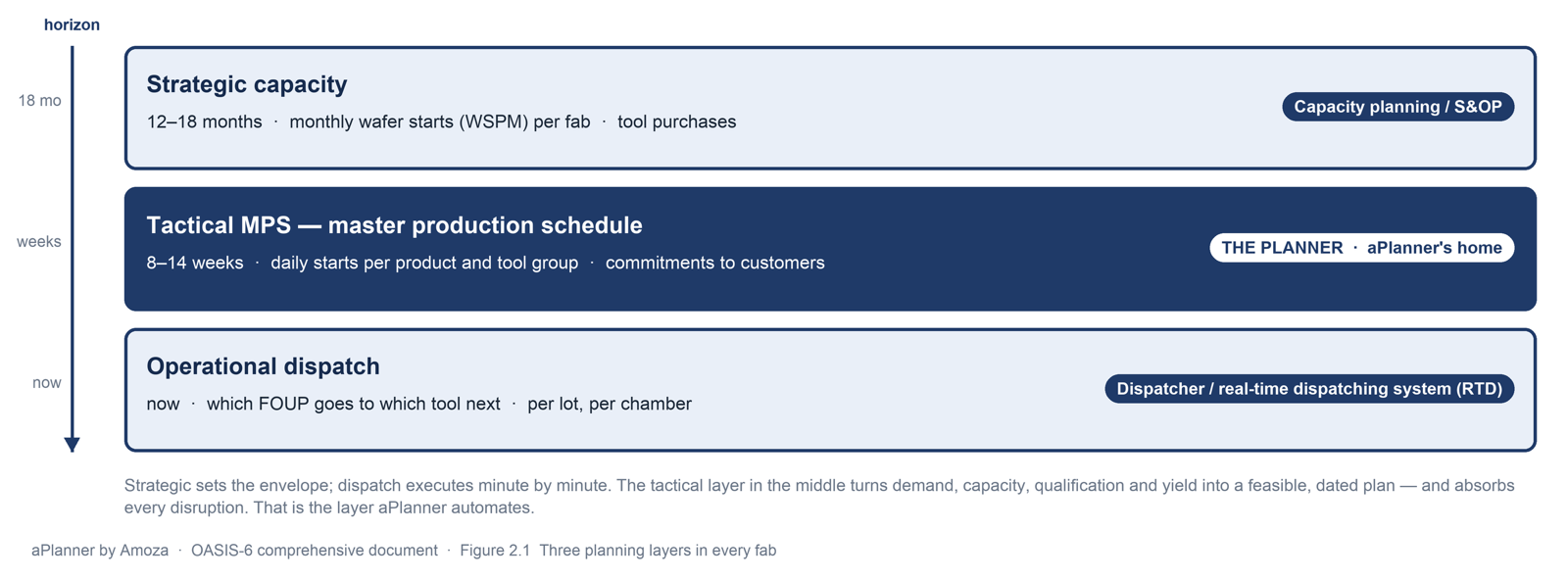
A fab plans at three horizons. Sales and operations planning sets quarterly wafer starts per product tier. The master plan turns that into weekly starts and milestone dates per lot family. Dispatch decides which lot a tool processes next. The master plan is where Excel takes over, because it is the layer where demand, capacity and yield meet, and where the incumbent tools have the weakest model of the fab.
Why a spreadsheet cannot hold a fab
A spreadsheet model is a list of lots with dates and a capacity table with hours. That representation is adequate for a plant with twenty operations and a fixed bottleneck. A wafer fab has 50–100+ masking layers, which translate into hundreds to more than a thousand process steps per route, and eight properties that a list of rows cannot express.
Reentrant flow
A wafer visits the same photolithography, etch and deposition tool groups dozens of times, once per layer. A lot at step 412 competes for the same scanner as a lot at step 38. A spreadsheet row per lot cannot express that the same resource is claimed by the same lot at different times.
Capacity is a tool × recipe × chamber matrix
Capacity is not "hours on PHOTO". It is which recipe is qualified on which tool, which chamber is up, which PM window is open. One qualification change moves feasible capacity for hundreds of lots. In Excel that matrix lives in the planner’s head.
Batch tools and transport
Furnaces and wet benches run batches of 100–150 wafers with minimum fill rules. A lot that arrives ten minutes after the batch closes waits hours. Batch formation is a combinatorial decision, not a cycle-time lookup.
Cycle time is a distribution
The same route takes 42 days at P50 and 51 days at P80. A plan built on averages is late by construction. Commitments must be made at a confidence level, which means the planner needs a risk model, not a sum of standard times.
Yield arrives six weeks late
Probe confirms yield long after wafer start. A −2% excursion on one product changes how many wafers must be started now to hold a good-die commitment later. Yield is therefore an input to the start plan, not a scrap factor applied afterwards.
The bottleneck moves
Product mix, qualification and PM move the constraining tool group from week to week. A static capacity sheet with a fixed bottleneck column is wrong by Wednesday.
Technology transitions overlap
A fab runs the outgoing node and the ramping node at the same time, on shared tools, with the new node on a learning curve. Generic tools treat the new node as a new product and miss the shared-tool coupling entirely.
Hot lots and the human loop
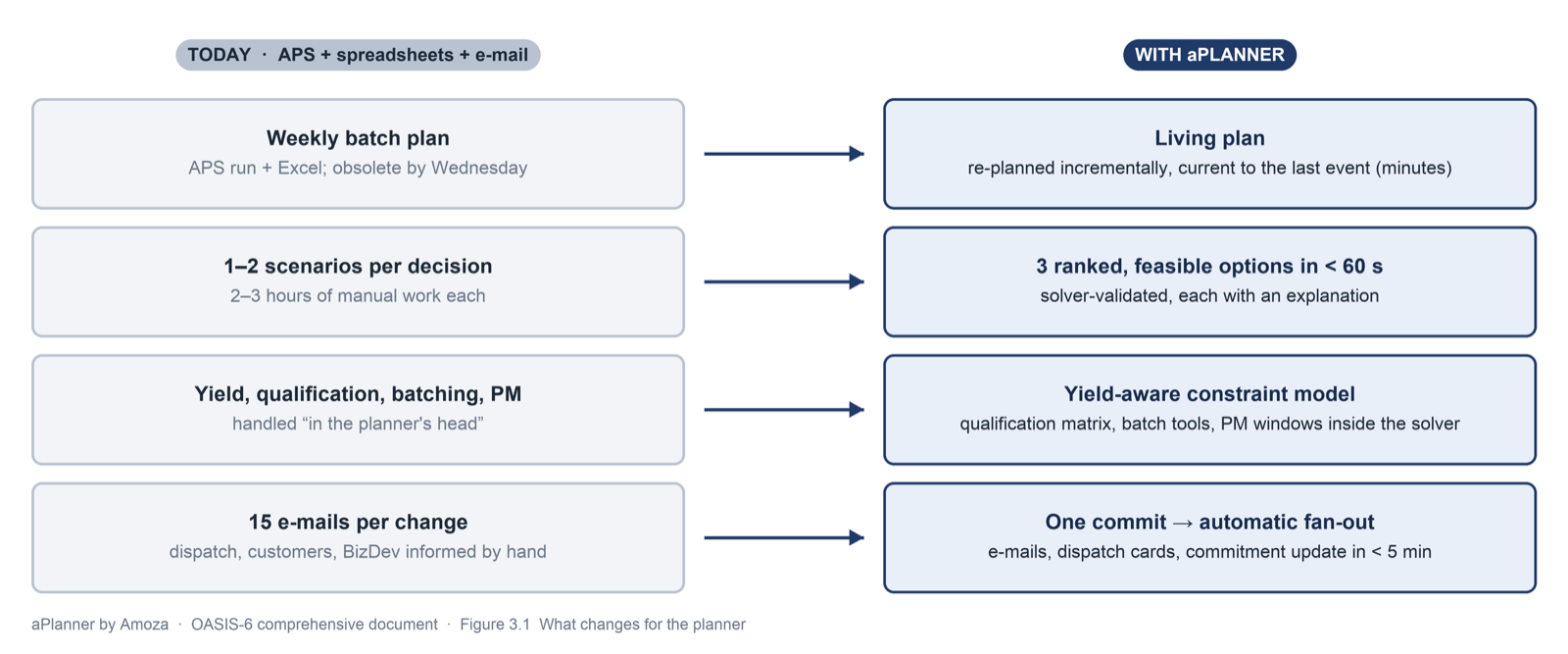
A customer escalation inserts a lot and ripples through every downstream step. Today the ripple is computed by e-mail: dispatch, the customer, business development, each informed by hand.
The consequence is well documented in the industry literature and matches what I have seen in practice: master-planning cycles of three to five days, roughly 70% of planner time spent collecting data from MES, ERP and spreadsheets, and plans that are obsolete before they are published. Those figures are published benchmarks and interview composites, not aPlanner measurements.
What changes when yield lives inside the optimizer
The incumbent approach schedules wafer starts and applies yield afterwards as a scrap factor. The alternative, and the core of what we are building in aPlanner, is to make the schedulable unit the pair (lot, step index), to put the tool × recipe × chamber qualification tensor, batch-formation rules and PM windows into a constraint model, and to feed yield in as an input rather than an output. Three design decisions follow.
Yield and bin distributions as optimizer inputs
Per step and per product, the live yield and bin distribution enter the model, so wafer starts, expected good die and bin mix are planned together. Plans then survive the ±10–15% weekly swings that break a start-only plan.
Anchored stability zones
Frozen, flex and far horizons bound how much a re-plan may move. The solver warm-starts from the published plan with a penalty on change, so a furnace failure reroutes eleven batches, not the whole fab.
Explainable re-planning
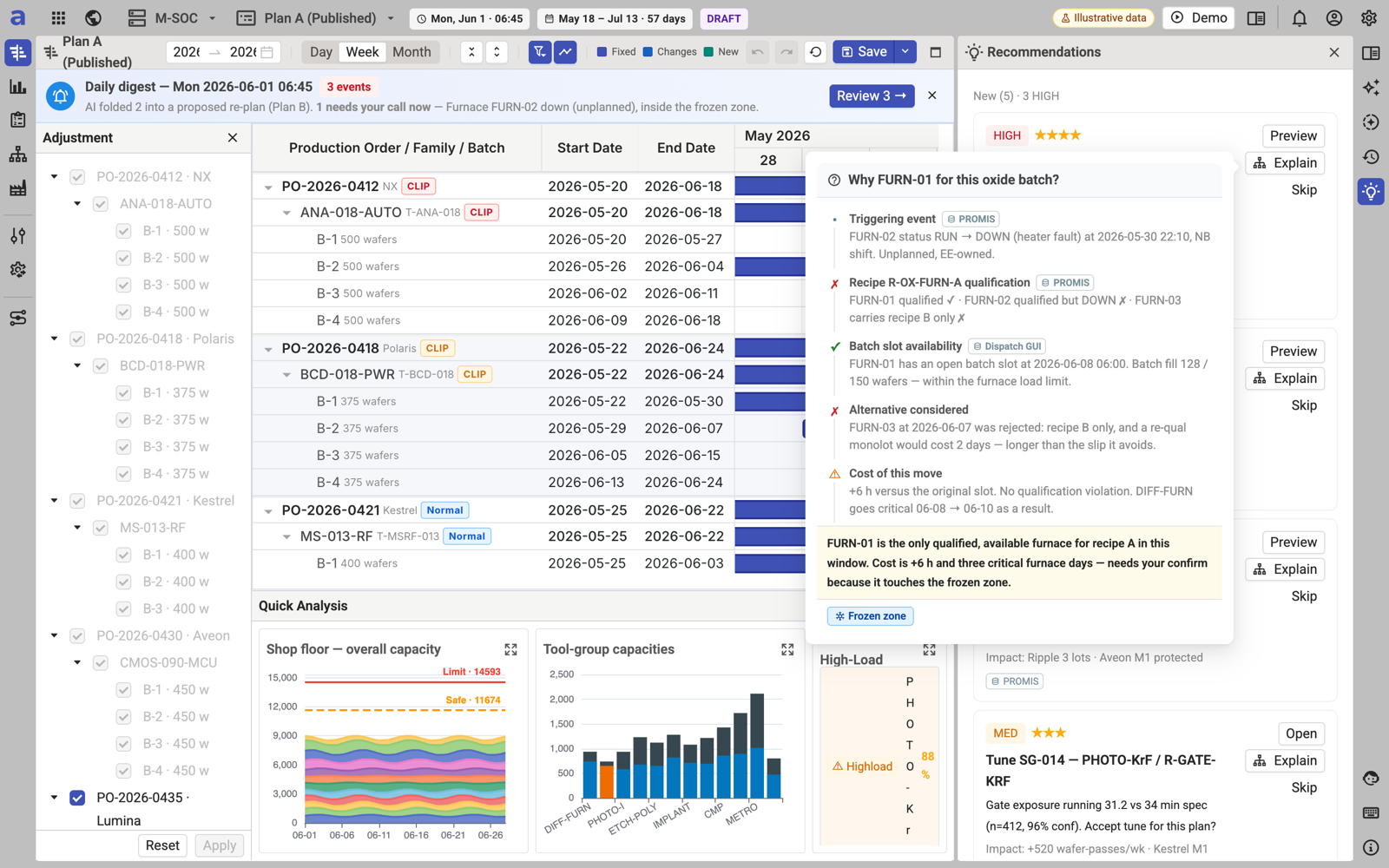
Every change carries the triggering event, the constraints it hit, the alternatives rejected and the KPI delta. The planner approves, edits or rejects, and the audit entry is written. This is what makes a conservative planning team trust the machine.
Trust is the actual bottleneck
A constraint solver that produces a feasible plan in under a minute is necessary but not sufficient. The reason planners keep the spreadsheet is that they can defend every number in it. So every re-plan in aPlanner carries its rationale chain: which event triggered it, which constraints it hit, what was rejected and why, and what the KPI delta is. The screen below is from the current MVP build on synthetic data; the planner opened it on a batch that was rerouted after a furnace failure.
What we are measuring in 2026–27
The design targets we are validating on synthetic fab data, and will test in the first Korean fab pilot in 2027, are a full-fab master schedule in under 30 minutes, 99%+ of generated plans feasible without manual repair, and a 5–15% yield-adjusted reduction in wafer starts for the same good-die output. They are targets, and they will be reported as results only when a pilot has produced them.
Target figures are design targets from simulation on synthetic fab data. aPlanner has no customer deployments yet; first pilot results are expected in 2027.
Danniel Nguyen (Nguyen Van Duong) is a senior software and AI engineer based in Suwon, Korea, who has delivered Industry Software and AI projects for Siemens Industry Software and Samsung Electronics. He is the originator of aPlanner, currently a pre-commercial MVP in validation, and the pre-founder of Amoza Korea.
danniel@amoza.aiSee the MVP on a planner's Monday morning
The prototype preview walks through a furnace failure, a hot lot and a yield excursion on synthetic data. Korean fabs, OSATs and suppliers can apply for the 2027 pilot program.