aPlanner is in MVP validation (Oct–Dec 2026). Figures are design targets. Join the 2027 Korea pilot →
THE APLANNER PLATFORM

Four AI modules, one planning engine

Forecasting tells the fab what the market will want; scheduling turns that into a feasible, yield-aware plan; simulation lets planners test every decision; analytics keeps everyone on the same live numbers.

aPlanner is the first product of the Amoza AI platform — from shop floor to customer door. Next: aMonitor (factory monitoring).
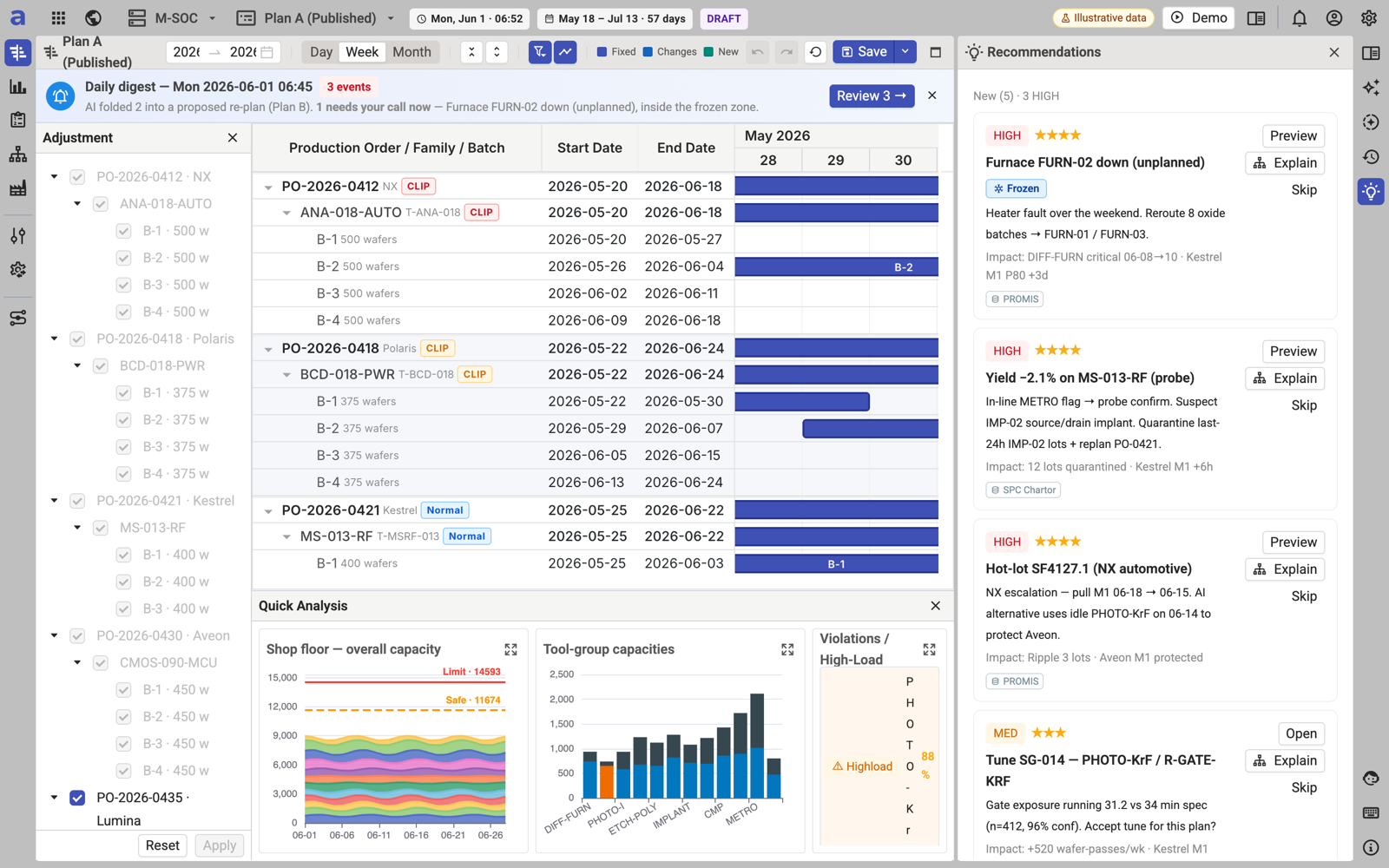
Recommendations — HIGH cards with impact one-liners, Preview and Explain

Four intelligent modules. One planning engine.

Each module replaces a spreadsheet, not a dashboard on top of one. All outcome figures are design targets. Validated on synthetic NAND-flash datasets — pilot results coming 2027.

Target figures are design targets from simulation on synthetic fab data. aPlanner has no customer deployments yet; first pilot results are expected in 2027.

WHAT CHANGES FOR THE PLANNER

From a weekly batch plan to a living plan

Today: an APS run plus Excel that is obsolete by Wednesday, one or two scenarios per decision, yield and qualification handled in the planner's head, fifteen e-mails per change.

With aPlanner: a plan re-planned incrementally to the last event, three ranked feasible options in under a minute, a yield-aware constraint model, and one commit that fans out automatically.
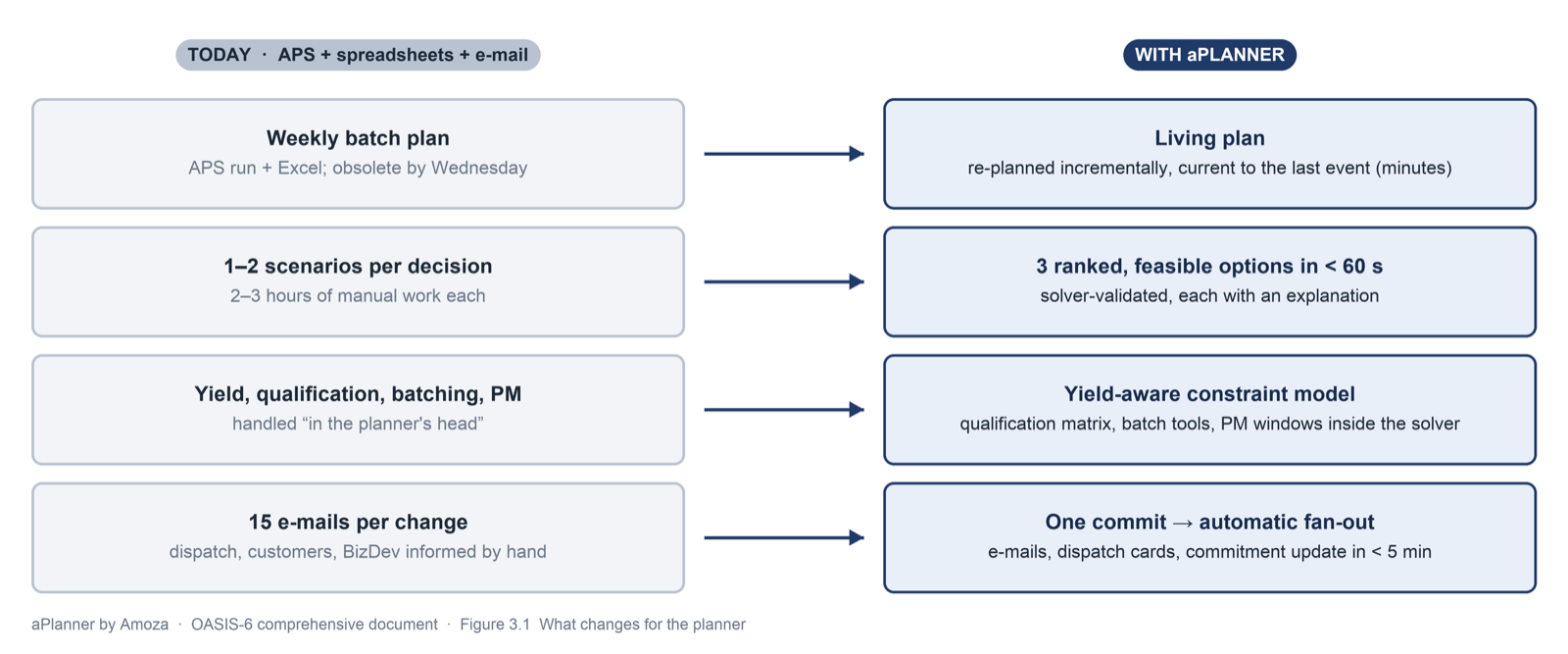
What changes for the planner — weekly batch plan → living plan; 1–2 scenarios → 3 ranked options; 15 e-mails → one commit
MODULE 1 · AI FORECASTING

Predict demand with confidence intervals
What it is
Ensemble ML (LSTM, Prophet, XGBoost, Transformer) forecasting demand per bit-density tier / SKU, 1 day to 24 months, with confidence intervals; the best model per segment is chosen automatically and retrained as data arrives.
What problem it solves
Excel forecasts reach 55–65% accuracy, worth US$20–50M a year of over- / under-production per large fab; AI / data-center orders swing 30%+ in a quarter.
What benefit it brings
Target 85–90% accuracy (+20–30 pts); less inventory in the wrong place; demand sensing catches hyperscaler swings weeks earlier.
Target: 85–90%forecast accuracy vs. 55–65% with Excel
Explore forecasting
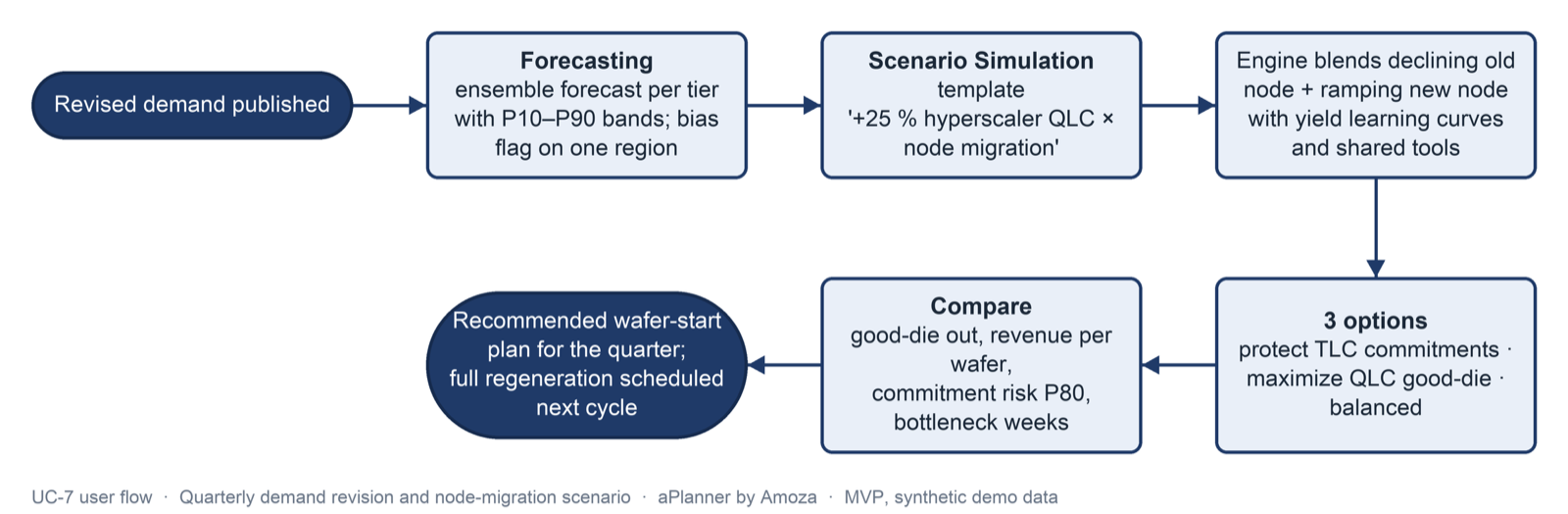
UC-7 — Quarterly demand revision and node-migration scenario (NAND)
MODULE 2 · INTELLIGENT SCHEDULING

A feasible, yield-aware plan in minutes
What it is
Constraint-based optimizer across tools, materials, labor, maintenance and changeovers, yield-aware over 50–100+ wafer steps, with automatic re-planning on disruptions.
What problem it solves
3–5-day manual cycles; about 70% of schedules need manual fixes; plans are outdated before they are finished; knowledge lives in planners’ heads.
What benefit it brings
Target: full-fab schedule in under 30 minutes (80% faster); 99%+ feasible plans; bin-sort allocation maximizing revenue per wafer.
Target: < 30 minfor a full-fab schedule, 99%+ feasible
Explore scheduling
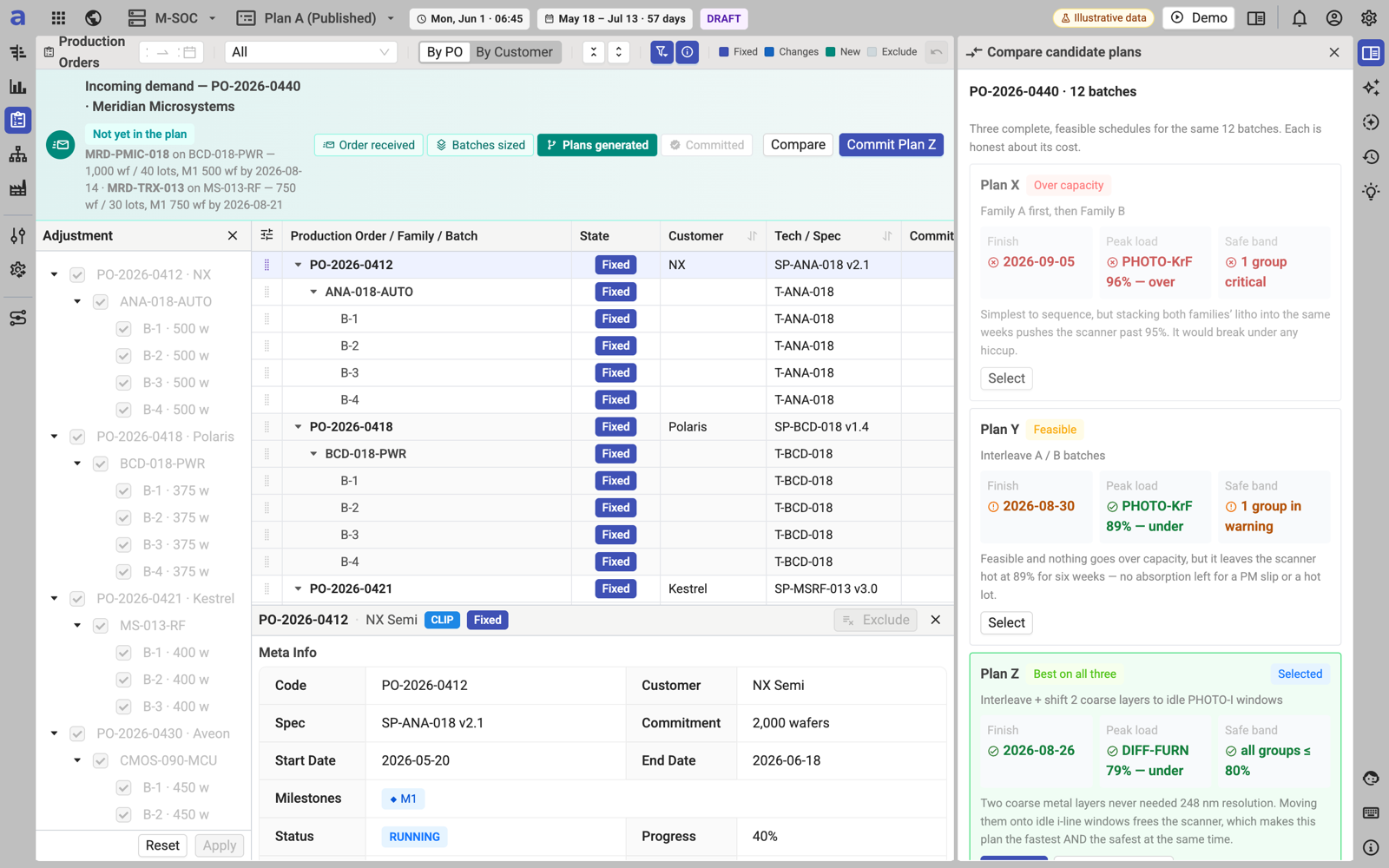
Compare — finish date, peak tool load, over-capacity, all-safe check
MODULE 3 · SCENARIO SIMULATION

Test every decision before you make it
What it is
Monte-Carlo what-if engine with templates (tool down, +20% hyperscaler order, yield −10%, node migration), side-by-side KPI comparison and an AI-recommended plan.
What problem it solves
A scenario takes days in Excel, so planners test 1–2 options and decide by gut feel — an estimated US$15–25M a year of sub-optimal decisions per large fab.
What benefit it brings
Target: minutes per scenario (95% faster); unlimited scenarios; quantified risk; decisions the whole team can defend.
Target: minutesper scenario instead of days
Explore simulation
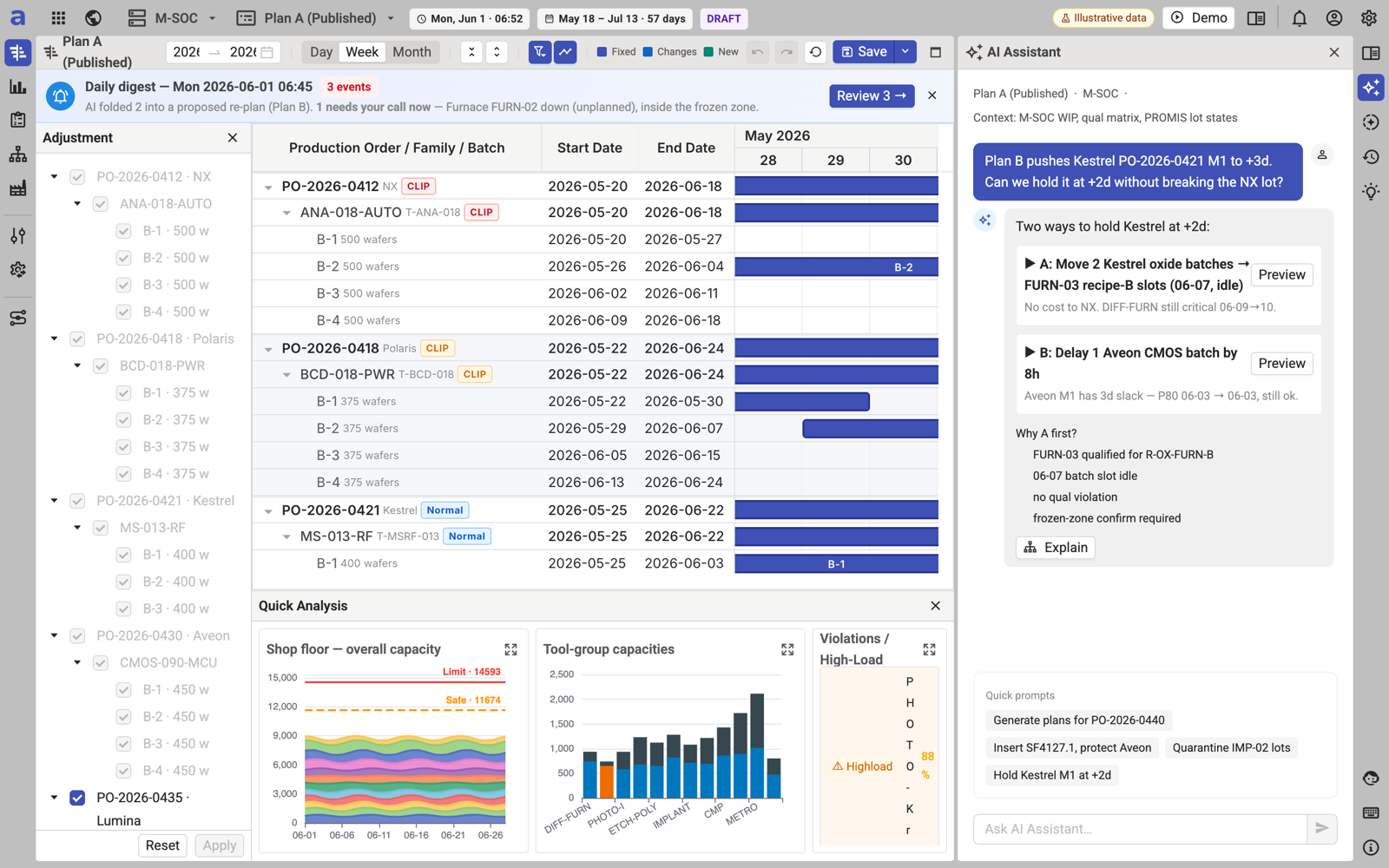
AI Assistant — “hold Customer K at +2 d without hurting the automotive lot” → 2 options
MODULE 4 · REAL-TIME ANALYTICS

One live source of truth for the whole fab
What it is
Live planning KPIs (adherence, OTD, WIP, utilization), anomaly detection, explainable recommendations; Korean / English planner and executive views.
What problem it solves
Data siloed in MES, ERP and spreadsheets; planners spend about 70% of their time gathering it; management sees yesterday’s numbers.
What benefit it brings
One always-current source of truth; target: planner time on strategy 20% → 60%; every recommendation auditable.
Target: 20% → 60%of planner time on strategy
Explore analytics
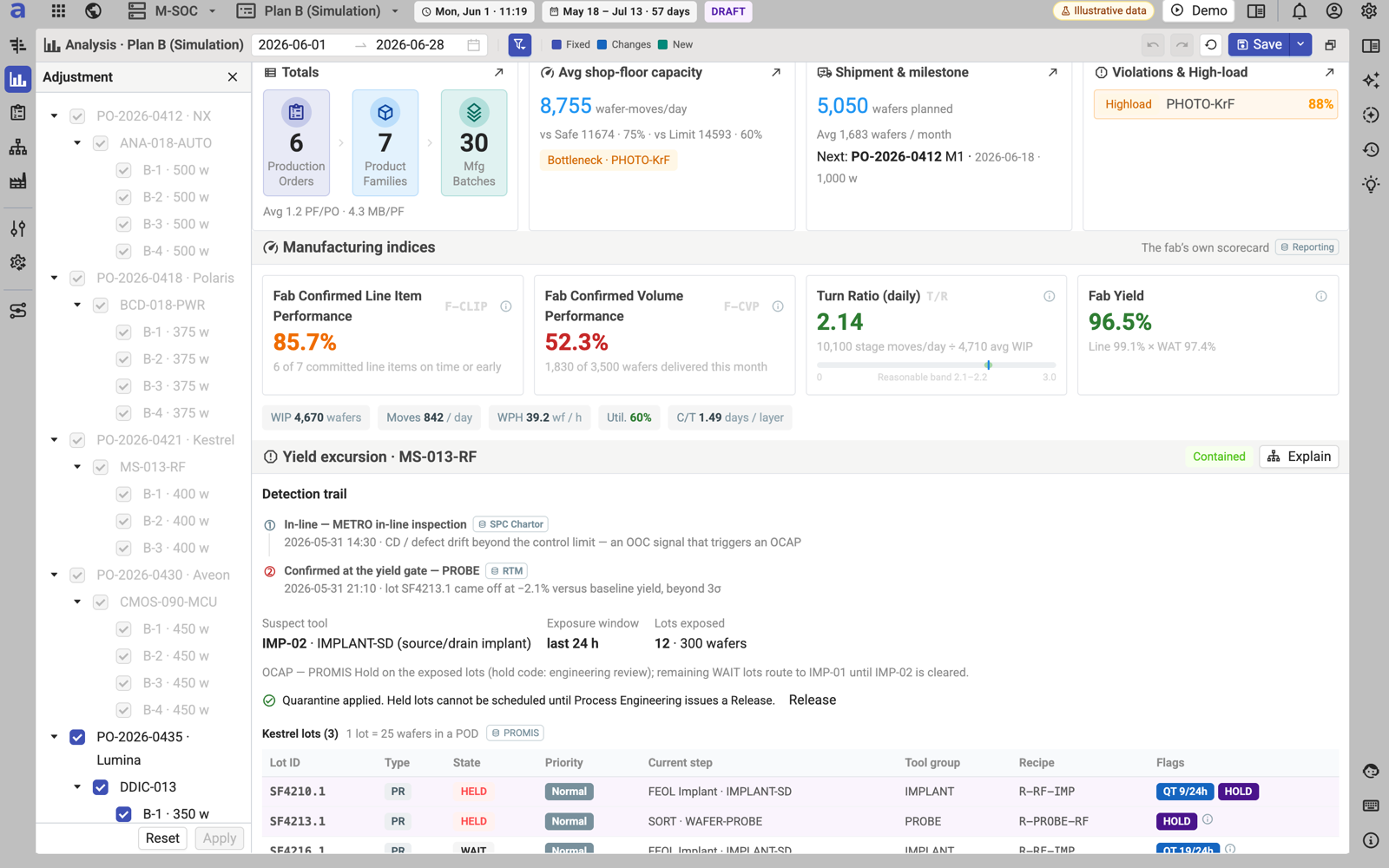
Analytics — executive view: adherence, OTD, WIP, utilization
ARCHITECTURE

Fits the fab's existing stack — data never leaves the site

MES · ERP (SAP) · yield / bin DB · planner spreadsheets → data layer (aFlow · aConnect) → AI core (aCore) → planner workspace (KR / EN, approvals) → back to MES / ERP.
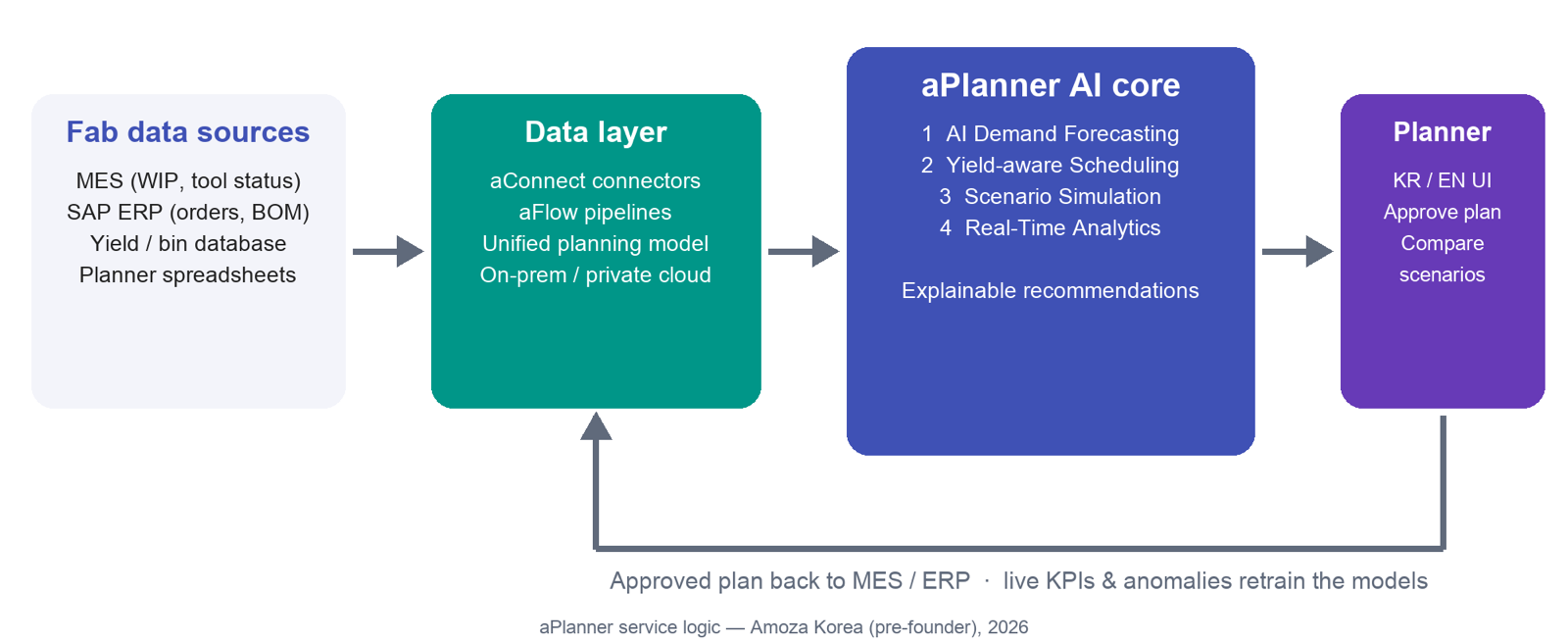
Service logic — MES · ERP · yield / bin DB · spreadsheets → data layer (aFlow · aConnect) → AI core → planner workspace → back to MES / ERP
Deployment
On-premise or private cloud inside the fab network (air-gapped option); SaaS on AWS Seoul for suppliers and SMEs; Kubernetes, same code everywhere.
Integration
Pre-built connectors for in-house MES, SAP ERP, yield / bin databases and Excel imports; read-only first, write-back after sign-off.
Security & governance
RBAC, SSO, full audit trail; planner-approval workflow. Roadmap: SOC 2 Type II (planned 2027–28), ISO 27001 (2028), K-ISMS.
Architecture & integration details

Technology

BackendPython / FastAPI
DataPostgreSQL + TimescaleDB
OptimizationOR-Tools / MILP (CP-SAT)
AI / MLPyTorch, XGBoost
FrontendReact (KR / EN)
RuntimeKubernetes on-prem or AWS Seoul

Security & deployment

On-premise / private cloud first for Korean fabs; air-gapped option
SaaS on the AWS Seoul region for suppliers and SMEs
Encryption at rest and in transit; RBAC; SSO; audit trail
Planner-approval workflow — AI recommends, people decide
Roadmap: SOC 2 Type II (planned 2027–28) · ISO 27001 (2028) · K-ISMS (planned)
Security & deployment details
DEVELOPMENT STAGE

Pre-commercial MVP, in validation

Not commercialized; no revenue; no customers yet. Working prototypes of scheduling, simulation and analytics on synthetic fab data; forecasting engine prototyped, dedicated view in the December 2026 build. The first Korean fab pilot is planned for 2027.

Done

Phase 1 — Foundation

Apr–Jun 2026
Done

Phase 2 — Concept

Jul–Sep 2026

Working prototypes on synthetic fab data

Now

Phase 3 — Validate

Oct–Dec 2026

MVP validation, Korean UI

Planned

Phase 4 — Launch prep

Jan–Mar 2027
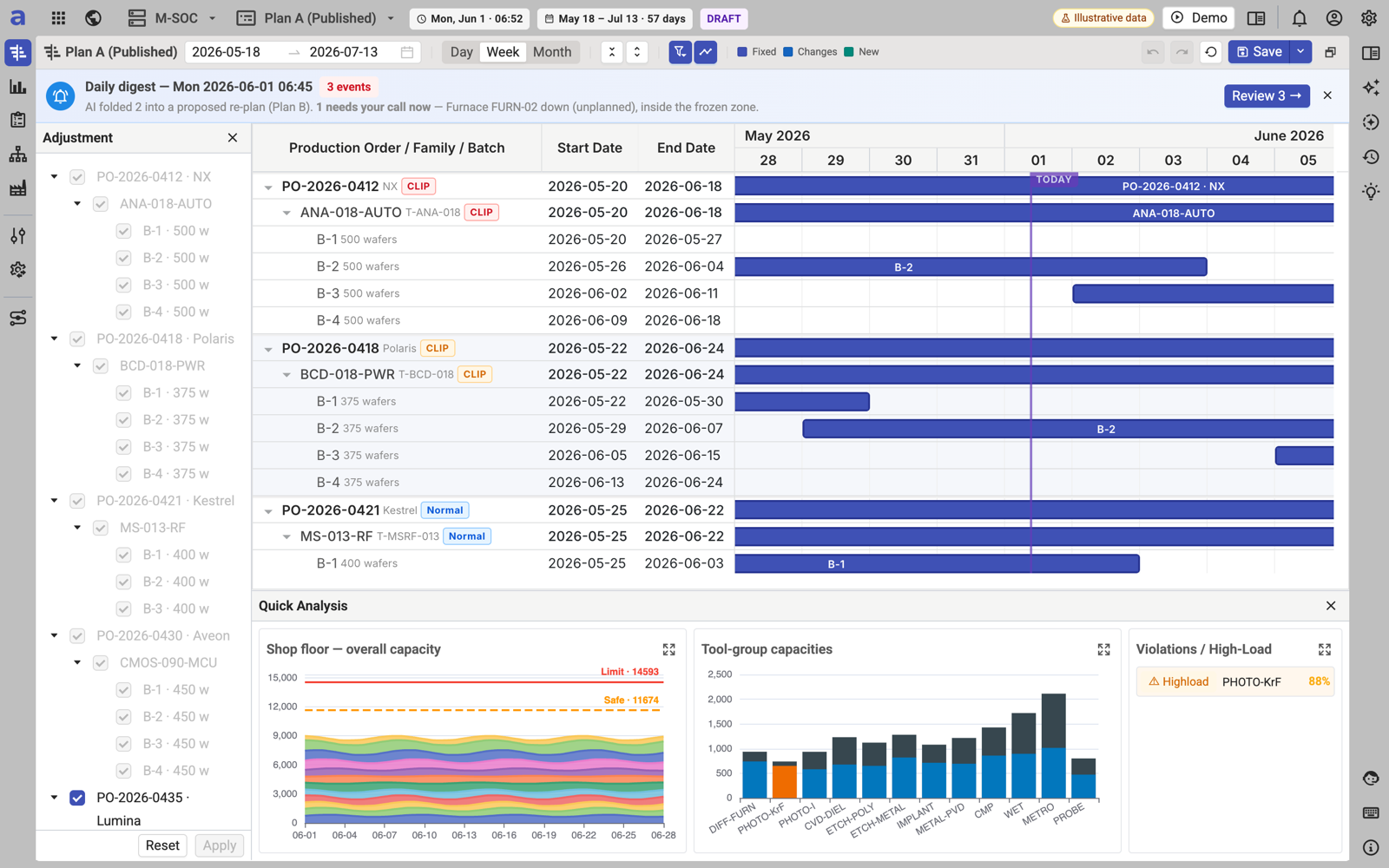
Daily Digest — 3 weekend events, 2 folded into a proposed re-plan, 1 needs the planner’s call
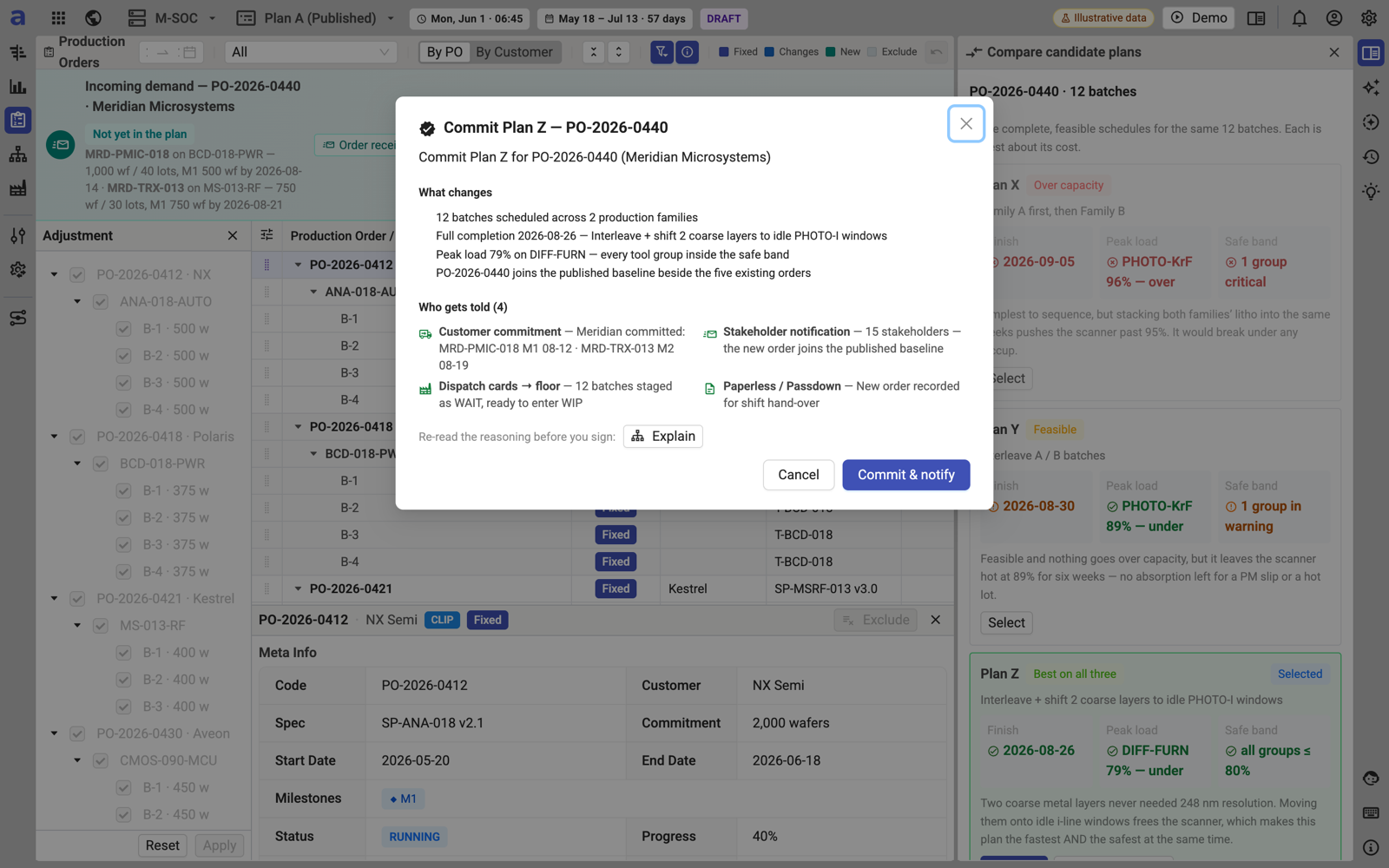
Commit confirmation — what changes and who gets told, with Explain before signing
EDITIONS & PRICING · KRW FIRST

Start with a pilot, grow by edition

Planning Readiness Assessment → pilot on one line (KRW 75–150M, 8–12 weeks) → Starter subscription from KRW 120–300M per year (≈ US$100–250K). One price list on both Amoza sites; indicative until the first Korean pilot is contracted.

View the price list

Be the first Korean fab to run aPlanner

The 2027 Korea pilot program: a paid readiness assessment, an 8–12-week pilot on one line, and a founder who sits next to your planners.

No commitment
Prototype walkthrough
Planning readiness assessment