
aPlanner - AI-POWERED PRODUCTION PLANNING
AI-powered production planning built for semiconductor complexity — yield-aware, constraint-based, scenario-driven — so Korean fabs can plan in minutes instead of days.
aPlanner is the first product of the Amoza AI platform — from shop floor to customer door. Next: aMonitor (factory monitoring).
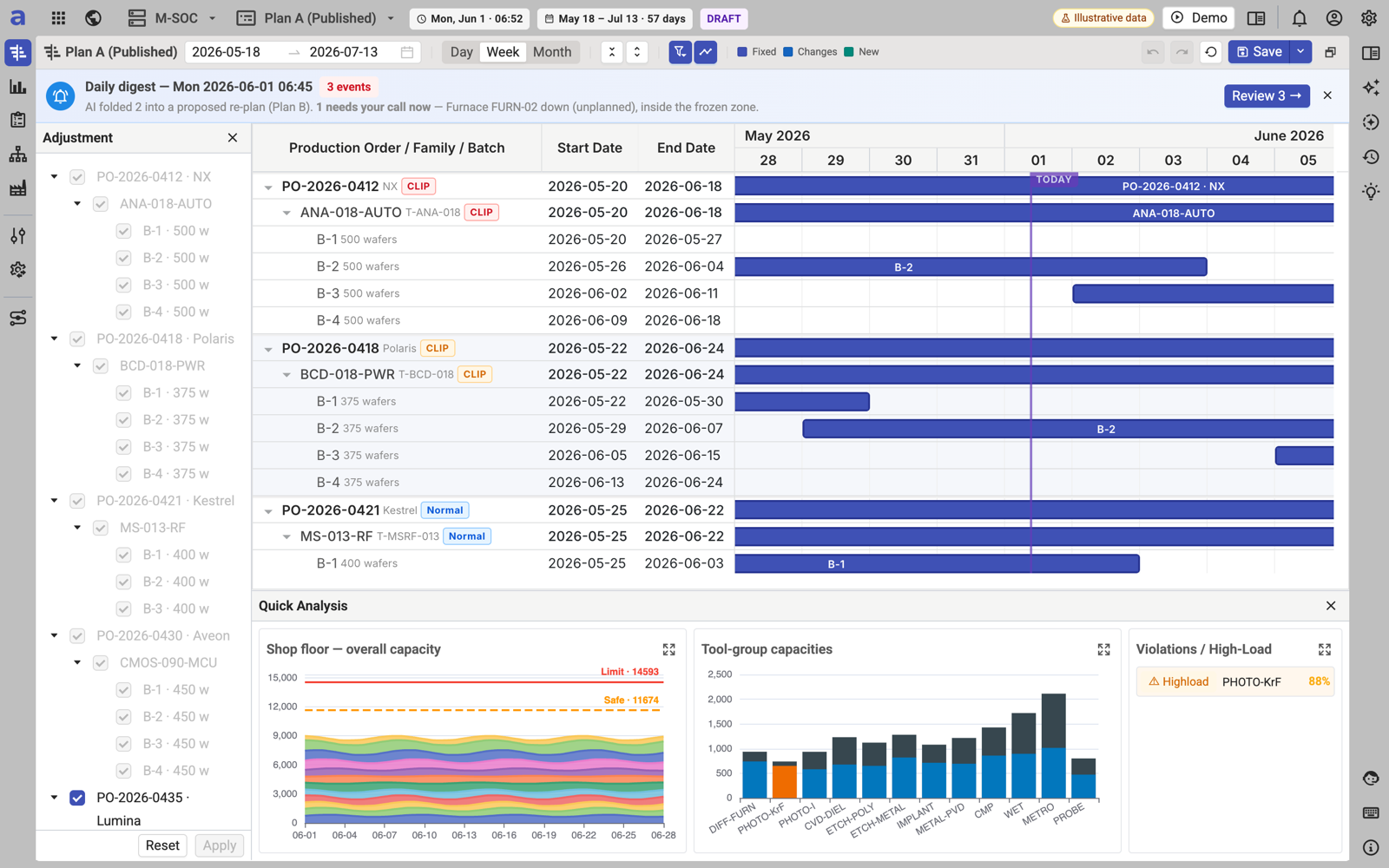
Validated on synthetic NAND-flash datasets — pilot results coming 2027.
The world’s most advanced fabs still plan in spreadsheets
50–100+ process steps, 3–6 month cycle times, ±10–15% weekly yield swings, continuous node migrations and demand that moves 30% in a quarter. When a tool goes down or a hyperscaler doubles its order, a planner needs a new plan in hours. Today it takes days, in Excel, with numbers nobody fully trusts.
Legacy tools deliver unreliable forecasts. The result: excess inventory, stockouts, and safety buffers nobody trusts.
By the time the plan is finished, a tool has gone down or a hyperscaler has changed its order. The plan is obsolete before it ships.
MES says one thing, ERP another, the yield database a third. Planners reconcile spreadsheets instead of making decisions.
Over- and under-production, missed demand and excess inventory — hidden in expedite fees and write-downs, year after year.
Industry figures from published benchmarks and the founder’s project experience in Korean fabs; not aPlanner customer data.
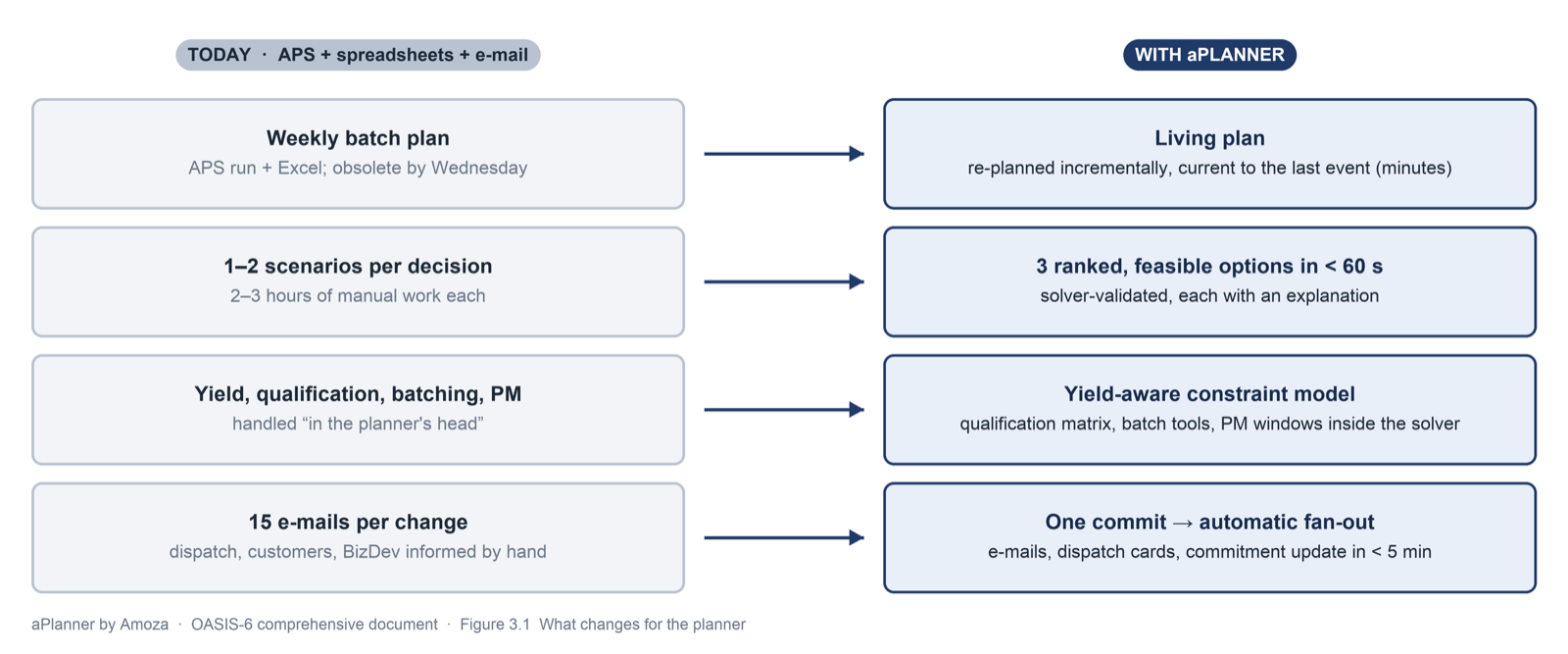
Four AI modules, one planning engine
Forecasting tells the fab what the market will want; scheduling turns that into a feasible, yield-aware plan; simulation lets planners test every decision before they make it; analytics keeps everyone on the same live numbers. Each module replaces a spreadsheet — it is not a dashboard on top of one.
Target figures are design targets from simulation on synthetic fab data. aPlanner has no customer deployments yet; first pilot results are expected in 2027.
Explore the platformDesign targets, stated as targets
These are the numbers the engine is being built and tested against on synthetic fab data. They become results only when a Korean fab pilot says so — in 2027.
Target figures are design targets from simulation on synthetic fab data. aPlanner has no customer deployments yet; first pilot results are expected in 2027.
What each module is, what it solves, what it brings
AI Demand Forecasting
Ensemble machine learning (LSTM, Prophet, XGBoost, Transformer) forecasting demand per bit-density tier or SKU, 1 day to 24 months out, with confidence intervals. The best model per segment is chosen automatically and retrained as data arrives.
Excel forecasts reach 55–65% accuracy, worth US$20–50M a year of over- and under-production per large fab. AI and data-center orders swing 30%+ in a quarter.
Target 85–90% accuracy (+20–30 pts); less inventory in the wrong place; demand sensing that catches hyperscaler swings weeks earlier.
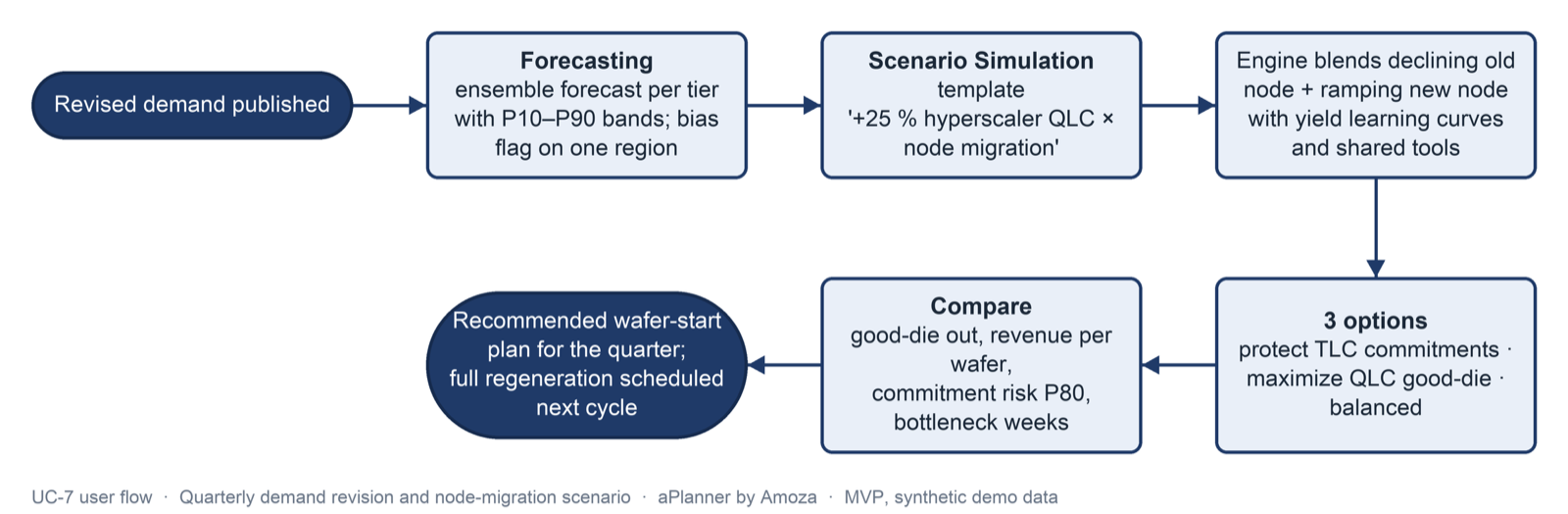
Forecasting view is in development for the December 2026 build; the UC-7 flow shows the intended workflow.
Target figures are design targets from simulation on synthetic fab data. aPlanner has no customer deployments yet; first pilot results are expected in 2027.
A planner’s Monday: furnace down, plan rebuilt in ~6 minutes
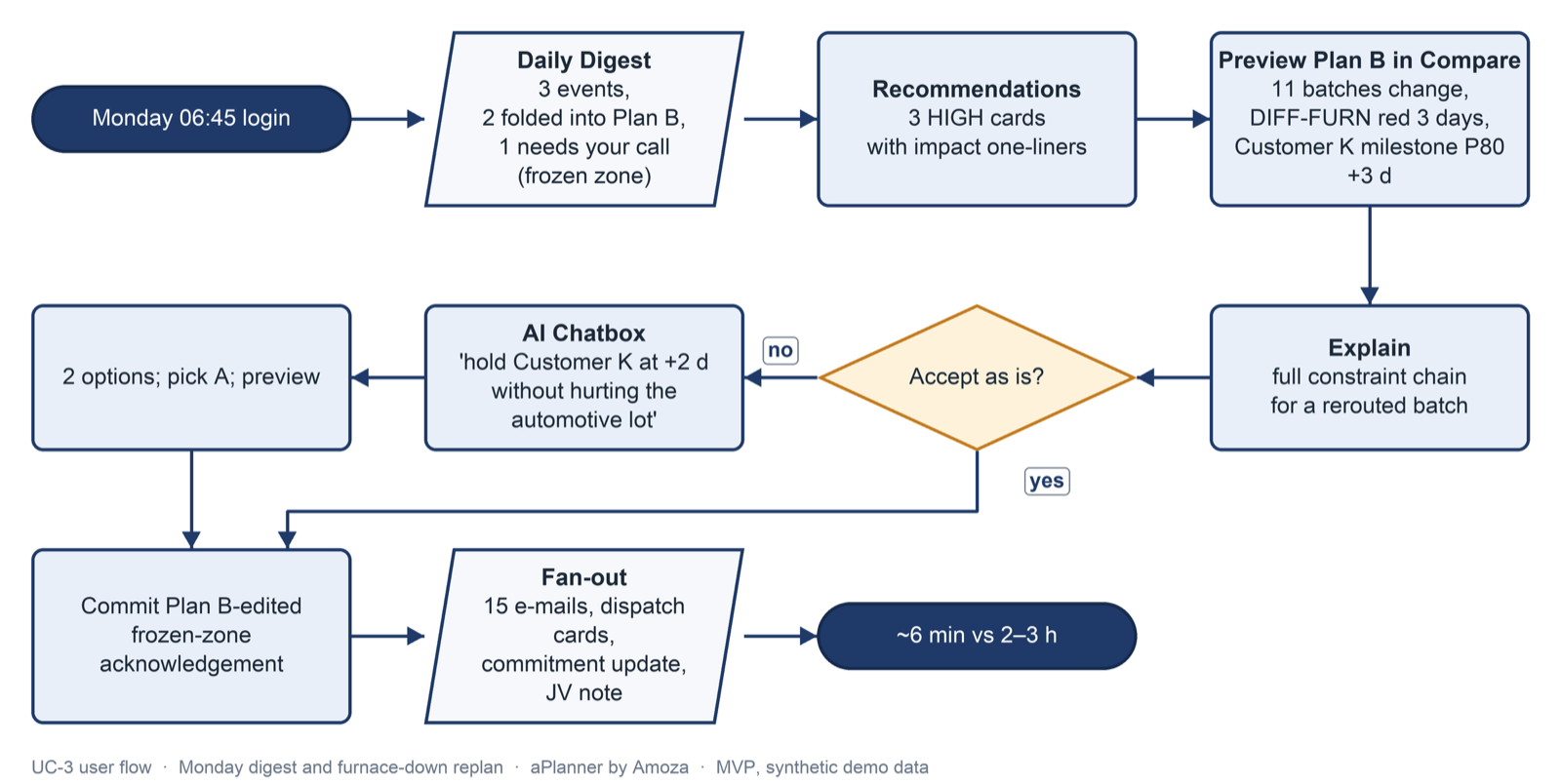
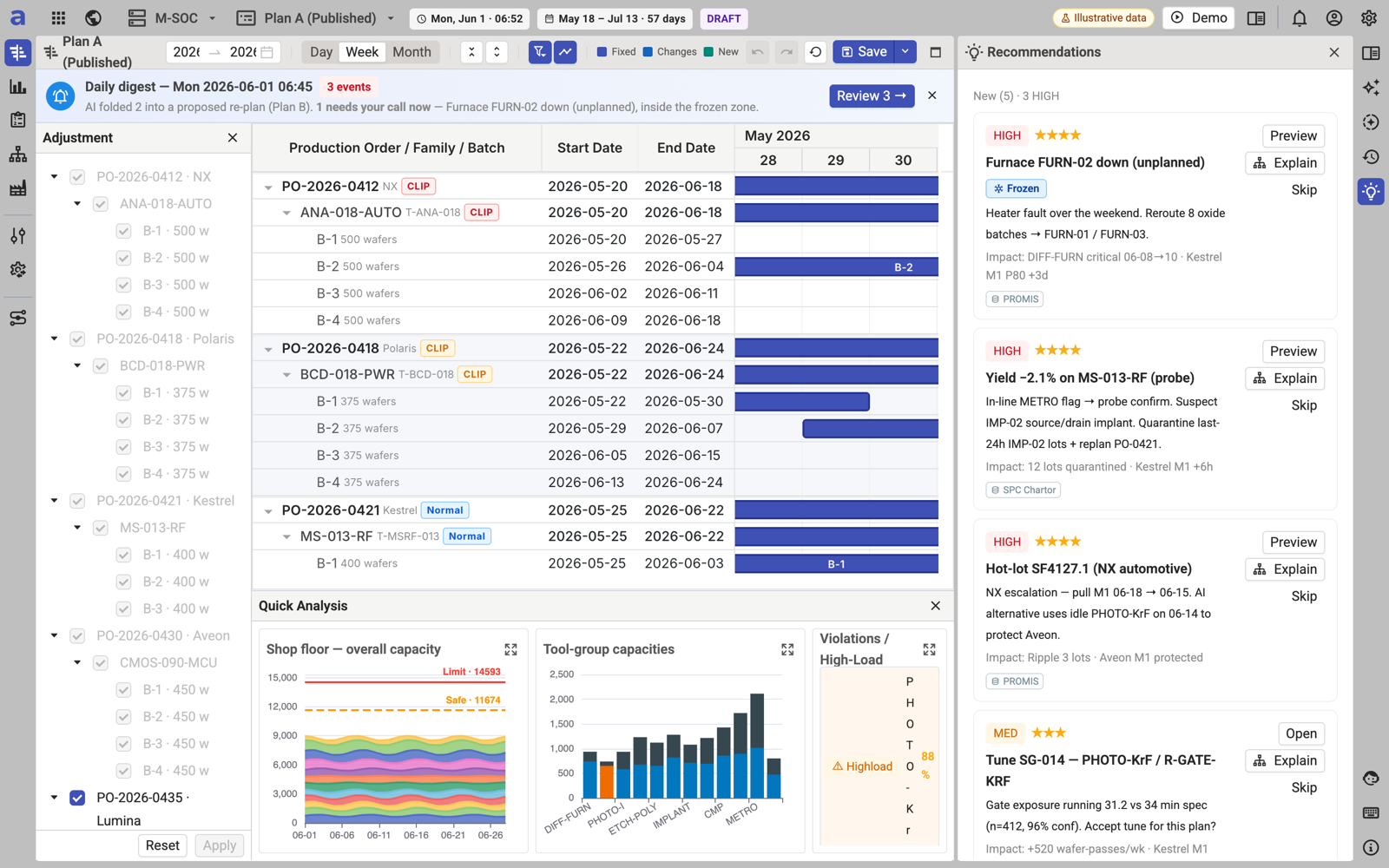
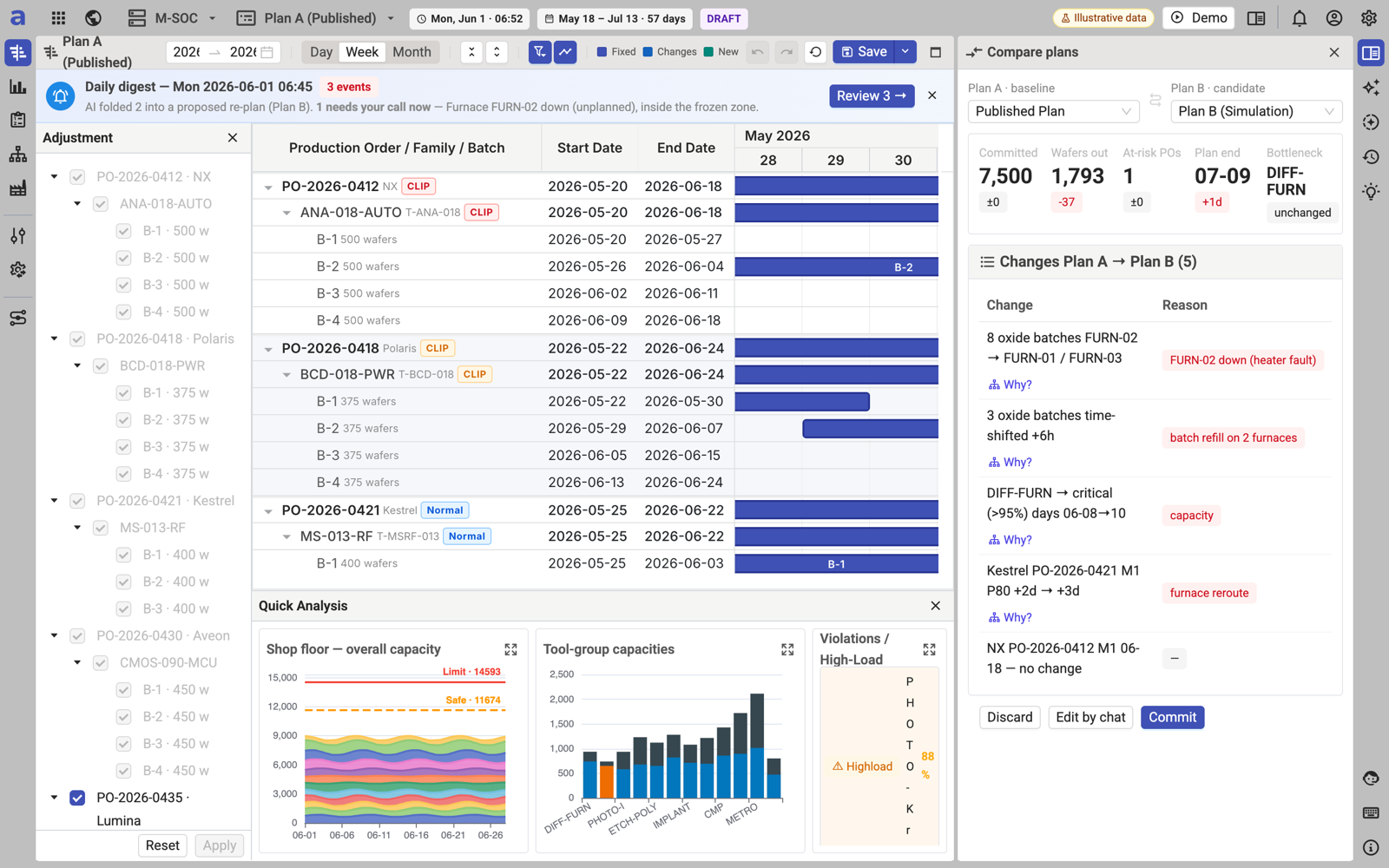
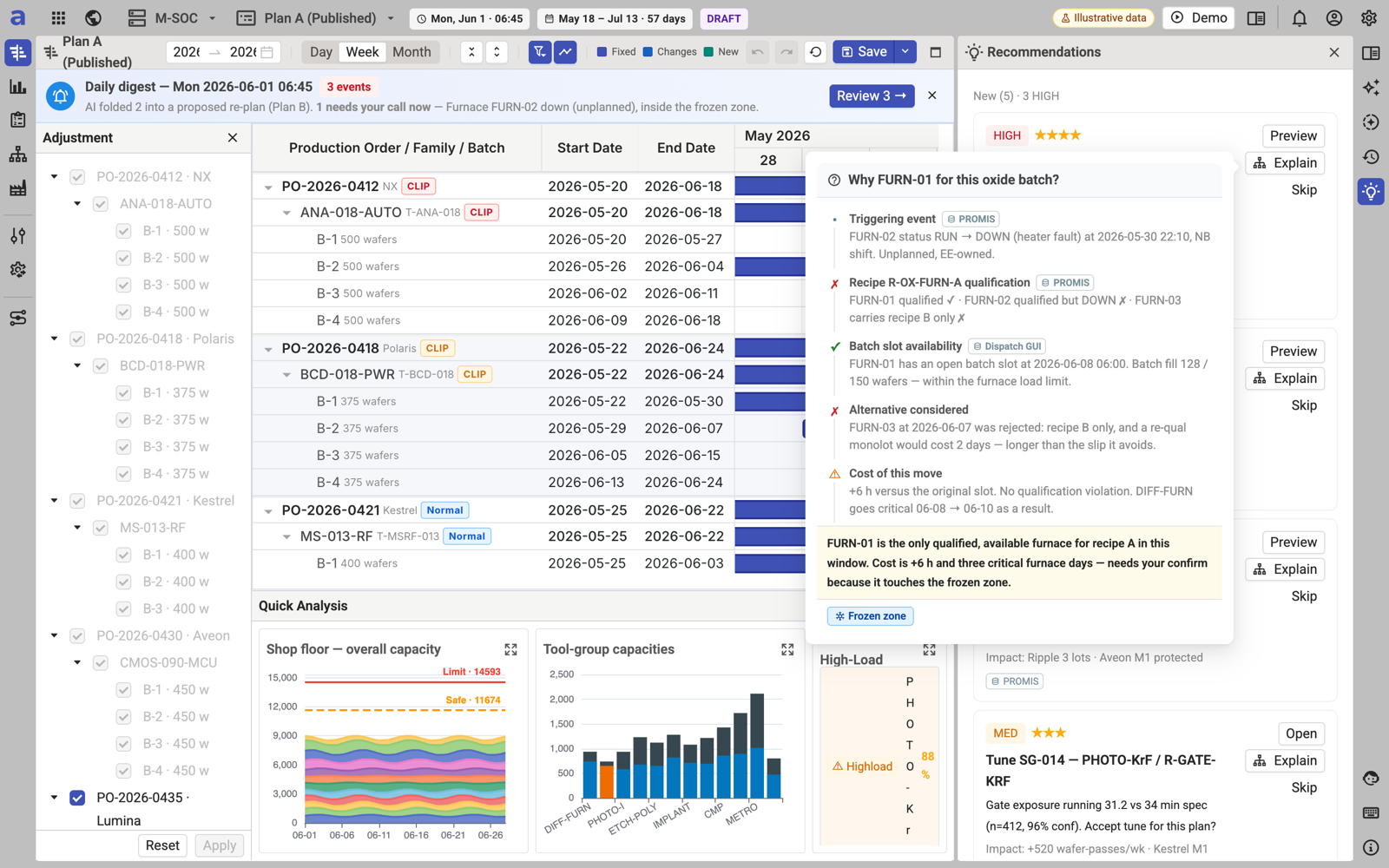
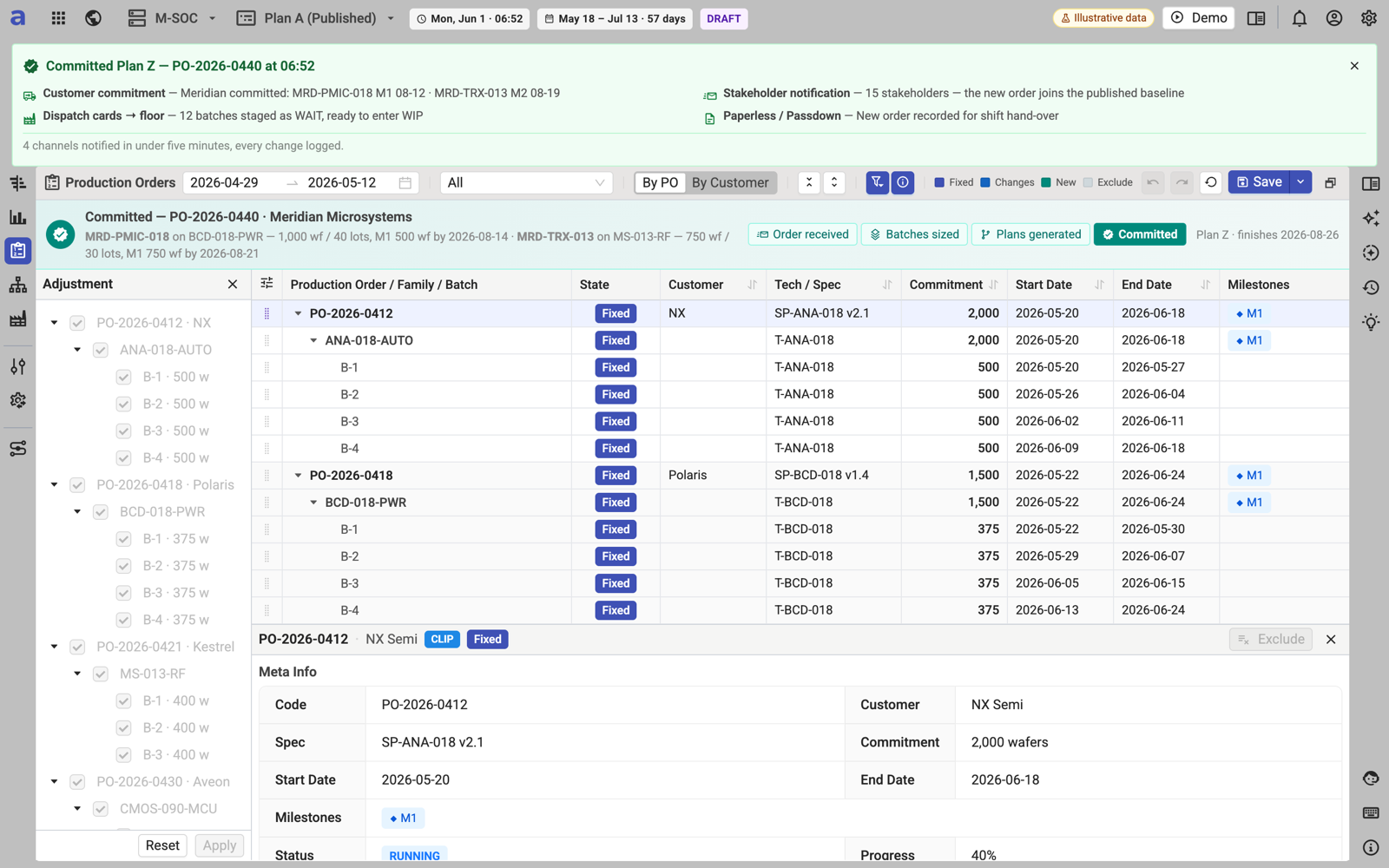
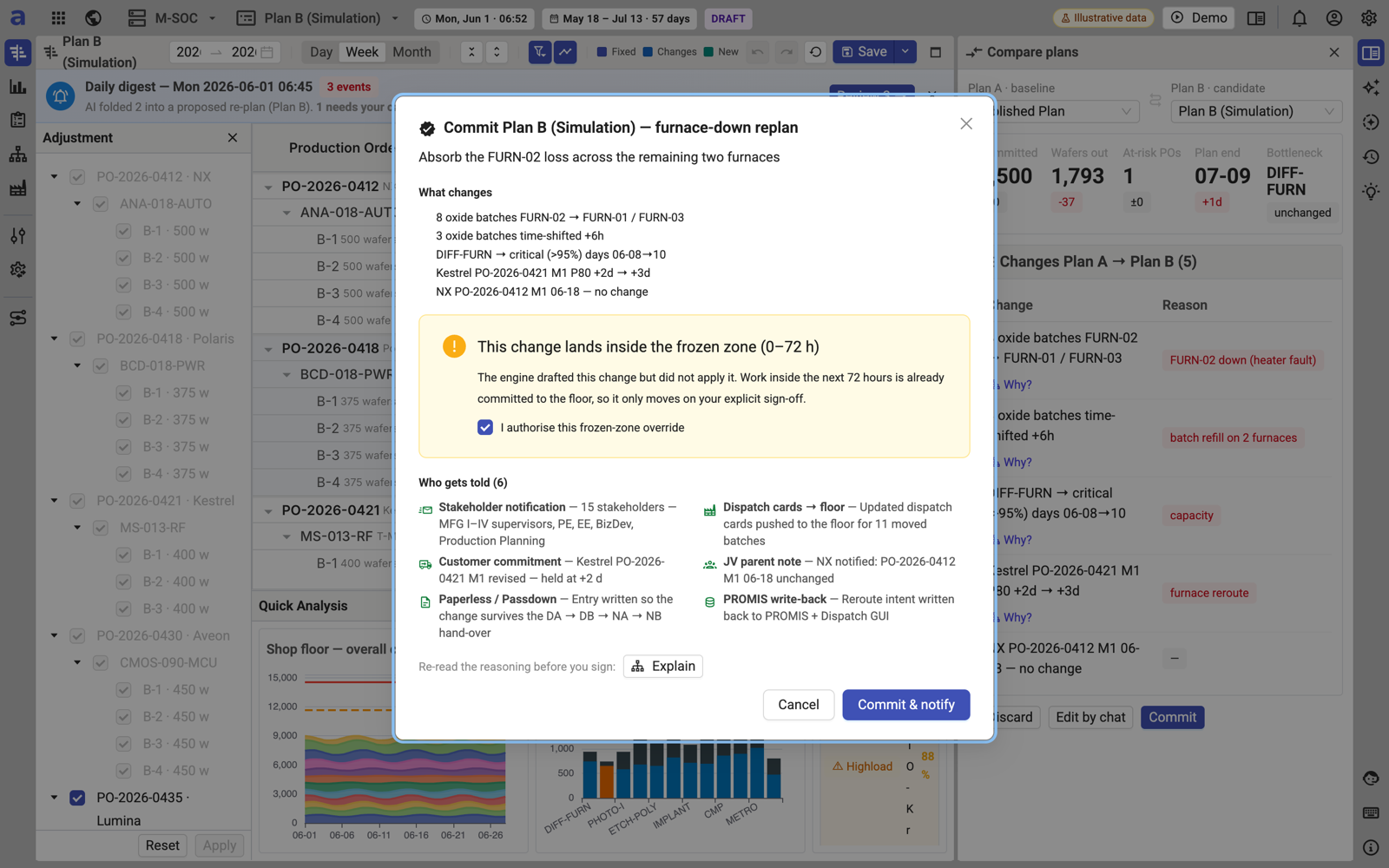
Saturday 22:10 a furnace fails. Monday 06:45 the planner logs in: the digest shows three weekend events, two already folded into a proposed re-plan, one that needs a human call because it touches the frozen zone. Preview, explain, adjust with the AI assistant, commit — and 15 e-mails, dispatch cards and the customer commitment update go out automatically. Target: about 6 minutes instead of 2–3 hours.
Land with one Korean memory fab, expand to the cluster
Korea makes the world’s memory: two of the top-three memory makers, hundreds of tier-1/2 suppliers and OSATs, and 16 new fabs planned in the Yongin–Pyeongtaek mega-cluster. Every new fab will need a planning team. aPlanner is built to answer the Korean fab’s first three questions.
Data stays in the fab
On-premise or private cloud inside the fab network — air-gapped option, read-only connectors first, no production data leaves the site; K-ISMS / ISO 27001 roadmap.
Korean fabs reject off-site production data. Cloud-first SAP IBP, o9 and Kinaxis stall in the security review; aPlanner clears the #1 objection on day one.
Korean systems landscape
Pre-built connectors for in-house MES, SAP ERP, yield / bin databases and planner spreadsheets; Korean SI / MES partners deliver; two Siemens Industry Software architects advise on MES / PLM integration.
Incumbents need 12–18 months of system-integrator customization; aPlanner targets 8–12 weeks to a running pilot because the Korean stack is the default, not a project.
Korean users, Korean support
Korean UI, reports and approval workflow; Korean hires in 2027 (planning domain, MES integration, business development); founder and support within an hour of the Yongin–Pyeongtaek cluster; KRW contracts with a Korean company.
Overseas vendors support in English from another time zone; aPlanner sits next to the planner, in Korean, at roughly half the incumbents’ entry price (Starter KRW 120–300M).
Fits the fab’s existing stack — data never leaves the site
Connect what the fab already has
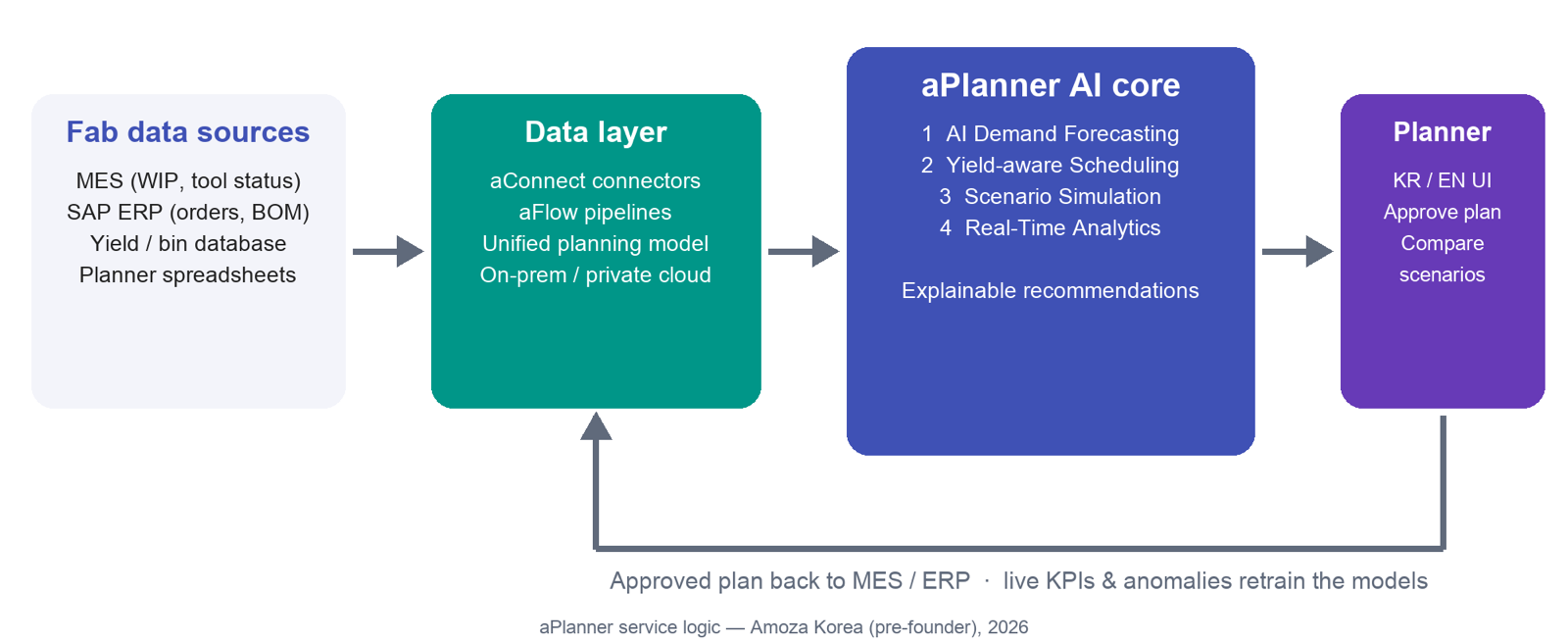
Read-only connectors to in-house MES, SAP ERP, the yield / bin database and the planners’ own spreadsheets build one versioned planning snapshot.
On-premise or private cloud inside the fab network — production data never leaves the site.
Forecast and detect
Ensemble models forecast demand per tier; the event router classifies tool-downs, yield hits and hot lots and decides what needs the planner’s call.
Best model per segment chosen automatically; every event carries its impact one-liner.
Solve, compare, explain
The constraint solver returns ranked, feasible options; the planner compares finish dates, tool load and commitment risk, and reads why each change happened.
Frozen / flex / far zones bound how much the plan may move. AI recommends, people decide.
Commit and fan out
One commit publishes the baseline, updates commitments, stages dispatch and notifies everyone affected. Every change is logged with its reason.
Write-back to MES / ERP only after sign-off. Live KPIs retrain the models.
Nobody has built an AI-native planner for the fab — here, in Korean
AI-native and built for the fab, not bolted on
Legacy APS is generic and its AI is an add-on; the AI-first vendors were built for consumer supply chains. aPlanner models yield curves, bin distributions, qualification matrices and node transitions inside the solver — the things that make a fab a fab.
Weeks to a running pilot, not years to go-live
Incumbents need 12–18 months of system-integrator customization. aPlanner is designed to deliver first value in 8–12 weeks: a paid readiness assessment, then a pilot on one line with the Korean MES / SAP / yield stack as the default, not a project.
Data stays in the fab. Support speaks Korean.
On-premise or private cloud, air-gapped if required, read-only first. Korean UI, reports and approval workflow, KRW contracts with a Korean company, and a founder and team within an hour of the Yongin–Pyeongtaek cluster.
Validated on synthetic NAND-flash datasets — pilot results coming 2027.
aPlanner has no customers, no revenue and no signed pilot yet. Working prototypes of scheduling, simulation and analytics on synthetic fab data; forecasting engine prototyped, dedicated view in the December 2026 build. The validation phase is under way; the first Korean fab pilot is planned for 2027 after a paid readiness assessment. Everything on this site is labelled accordingly.
Be the first Korean fab to plan with aPlanner
The 2027 design-partner program starts with a planning readiness assessment on one fab or line, followed by an 8–12-week pilot with the planners who will use it. Eligibility: Korean fabs, OSATs and tier-1/2 suppliers.
Prefer to talk? Call the founder in Korea at +82 10-7785-2831